Link to Novels

Wednesday, July 30, 2025

The Horror of a Trillon in Health Care Cuts - Dr. Kolb, CEO of the Leukemia & lymphoma Society, Comments...


E. Anders Kolb, MD President and CEO, 
The Leukemia & Lymphoma Society
29 July

"In May, I shared my grave concerns about a House-passed bill that could lead to at least 15 million people losing health insurance coverage. I’m deeply disappointed to report that Congress has now passed a final version that could lead to 17 million losing health insurance coverage. Last Friday, President Trump signed the bill into law. 


We’re already hearing concerns from patients and caregivers who know intimately how critical health coverage can be. It’s often the difference between getting treatment and going without. Several studies confirm their experiences: people without health insurance and those with interruptions in coverage have worse outcomes. As an organization, The Leukemia & Lymphoma Society  (LLS) is committed to helping patients navigate these changes individually—while mitigating their impacts on a macro level. 


Congress’s plan to decrease federal healthcare spending means that millions more people would find themselves without health insurance. This law is misguided, as it considers only one side of the equation: expenditures. But it does not account for liabilities. 

Decreased access to care—a side effect of this law—would mean patients are diagnosed less quickly, leading to longer treatments, higher costs, and worse outcomes. This will not only threaten lives but also put increased pressure on the healthcare system, especially rural hospitals.  


By disrupting care for millions of Americans, Congress did not take a scalpel to the budget—it’s more of a sledgehammer. Such broad targeting focuses on the dollars that will be saved, while not considering the entire picture. Failure as a nation to provide adequate healthcare for all will cost us more in the long run, not only in dollars and cents but also in birthdays, anniversaries, graduations, and in precious time with loved ones. 


I want to express my deep gratitude to blood cancer advocates who shared their concerns about this bill with members of Congress. Although this wasn’t the outcome we hoped for, your calls, emails and in-person meetings made a difference. You were successful in preventing the even deeper cuts that lawmakers considered throughout the past six months.  For example, in the last hours of Senate consideration, you helped beat back an attempt to completely wind down the Medicaid expansion (which 16 million Americans rely on for coverage). You also stopped policies that would have dramatically decreased pediatric Medicaid enrollment and further increased state Medicaid funding cuts. 


LLS will never stop fighting to ensure all patients have access to the care they need. We are committed to engaging at the federal and state levels to mitigate the damage and to continue defending vital health insurance programs. Patients deserve better."

Krugman -"Fossil Fool - How Europe took Trump for a Ride..."


Paul Robin Krugman is an American New Keynesian economist who is the Distinguished Professor of Economics at the Graduate Center of the City University of New York. He was a columnist for The New York Times from 2000 to 2024

 "Like many U.S. institutions, the European Union has abysmally failed the Trump test. The EU is an economic superpower and could have retaliated effectively against Trump’s illegal tariffs — illegal under both U.S. and international law. Instead, Europe did nothing and even made some apparent concessions.

But notice my wording: apparent concessions. The optics of the Trump-EU deal were humiliating, and optics matter. If you examine the substance, however, it starts to look as if Europe played Trump for a fool. Specifically, a fossil fool.

The EU made two sort-of pledges to Trump. First, that it would invest $600 billion in the United States. Second, that it would buy $750 billion worth of U.S. energy, mainly oil and gas, over the next three years. The first promise was empty, while the second was nonsense.

About those investments: European governments aren’t like China, which can tell companies where to put their money. And the European Commission, which made the trade deal, isn’t even a government — it can negotiate tariffs but otherwise has little power. On Sunday Politicospoke with Commission officials, who effectively confirmed that the investment pledge was meaningless:

[S]peaking Monday, two senior European Commission officials clarified that money would come exclusively from private European companies, with public investment contributing nothing.

“It is not something that the EU as a public authority can guarantee. It is something which is based on the intentions of the private companies,” said one of the senior Commission officials. The Commission has not said it will introduce any incentives to ensure the private sector meets that $600 billion target, nor given a precise timeframe for the investment.

So what the EU actually promised on investment was nothing, Nichts, rien.

The pledge to increase U.S. energy exports was a lot more specific and gave a timeframe. But it’s not going to happen. In fact, it’s going to not happen on three levels.

First, the European Commission, which can’t tell the private sector where to invest, is equally unable to tell the private sector where to buy oil and gas. How would that even work?

Second, the promised level of EU imports is probably physically impossible. Shipping liquefied natural gas (LNG), in particular, requires specialized infrastructure at both ends. On the US side, LNG terminals are already operating at capacity, while Europe’s LNG facilities are “stretched to their limits.” The EU just promised to vastly increase energy imports from America over the next three years, but it’s doubtful whether Europe could build any of the infrastructure needed before the end of that period, even with a crash investment program.

And why would anyone undertake such an investment program in a continent that is rapidly shifting toward renewable energy? As one energy analyst told the Financial Times,

European gas demand is soft and energy prices are falling. In any case, it is private companies not states that contract for energy imports. Like it or not, in Europe the windmills are winning.

Emphasis added because as everyone knows, Trump has a blind, irrational hatred for wind power.

Finally, even if Europe somehow managed to overcome the legal and physical obstacles to buying a lot more fossil fuels from America, both oil and LNG are fungible commodities traded on global markets. This means that any increase in purchases from Europe would reroute U.S. exports rather than increasing them: We’d sell more to Europe but less to, say, Japan and China.

So a big increase in U.S. energy exports driven by demand from Europe is not going to happen. But how will Europe explain its failure to follow through?

It might not have to. Back during Trump’s first term, China promised to buy a lot of U.S. agricultural goods but never did. As far as I know, Trump never made an issue of it. He got to announce a big deal, then lost interest.

And if the issue does come up, if there’s one thing officials at the European Commission are really good at — maybe better than anyone else on earth — it’s bureaucratic delay and obfuscation. Maybe at some point big, strong European men with tears in their eyes will meet with Trump and say, “Sir, we have a temporary hangup over clause #14159 of the 1986 Single European Act. But we’ll get it cleared up any day now.”

Bottom line: Whatever Trump may think, Europe is not going to provide a big boost to U.S. fossil fuel production. He won’t like that, if anyone tells him. But the rest of us should be glad. As I’ve written before, renewables are clearly the energy technology of the future. Trump and his allies are Luddites, trying to stand in the way of progress and keep us burning fossil fuels. Their “burn, baby, burn” obsession is very bad for America and the world. But at least we can be reasonably sure that Europe won’t help, um, fuel that obsession."

Saturday, July 26, 2025

Grizzlies Were Raiding Montana Farms. Then Came the Kangal (Video )

 Bears have recently acquired a fondness for the good eating found around grain bins on Montana’s plains. That’s a big problem for humans and grizzlies alike.

Catrin Einhorn made friends with large dogs in Teton, Pondera and Toole Counties in Montana while reporting this article. - Published July 22, 2025


General info on this breed


Wesley Sarmento and Patton on the Leys family farm in May.Credit...John Stember for The New York Times

"The grizzly bears feasted on piles of spilled wheat and barley. They broke into grain bins. They helped themselves to apples from family orchards. Sometimes they massacred chickens or picked off calves.

Once nearly eradicated from the lower 48 United States, grizzlies are growing in population and spreading onto Montana’s plains, where they had not roamed in perhaps a century.

In their travels, they’ve acquired a fondness for the good eating to be found in farmyards.

This is a grave problem for both humans and bears. The safety of farmers and their families is at stake, and so is the survival of the bears, which could get themselves killed by threatening people’s lives and livelihoods.

Enter the bear dogs. This one’s name is Patton, and he’s a Turkish Boz shepherd.

Farms are not the only places where grizzlies are showing up, and all those bears, understandably, have humans very worried.

As conflicts have increased around the state, so have calls to remove the bears from protection under the Endangered Species Act, including through current legislation in Congress aimed at a population of bears to the south, around Yellowstone National Park. 

Removing federal protection would let the state hold a hunting season for grizzlies, which many Montanans see as necessary.

“There are too many bears,” said Mike Leys, who owns Patton and runs a farm near Choteau, Mont. He said he wished farmers could shoot problem bears that come on their property.

But amid the controversy, dogs are an important strategy in a complicated quest for coexistence, according to a growing number of researchers and farmers. By keeping the bears away from farms, dogs can help prevent conflicts before they start.

“The bear dogs are there to basically change the calculus in the bear’s head,” said Wesley Sarmento, a former bear manager for Montana’s wildlife agency. “To switch it from these farms being a place where they’re getting benefits, to being now a place of risk.”

Mr. Sarmento, whose job was to keep humans and bears safe by keeping them apart, found his way to the dogs out of desperation. The calls and texts from farmers wouldn’t stop, and nothing seemed to work to keep the bears away.

Among the frequent callers were Steve and Julie Ahrens, who’ve been farming wheat, barley and chickpeas outside Shelby for more than 40 years. Before that, Mr. Ahrens’s grandfather worked the same land. They had never seen a bear on the farm before 2019.

By June 2020, they had four grizzlies visit in a single week.

The Ahrenses would watch with a mix of wonder and horror as bears ambled around just yards from their home, often nosing around by the grain bins.

“They figured out if they just pushed on the door, they could get the grain to trickle out,” Mrs. Ahrens said of an older bin farther from the house. “So we called it the self-feeder.”

Mrs. Ahrens stopped taking her morning walks, and the couple grew fearful of letting their grandchildren play outside.

They texted Mr. Sarmento a lot, and he tried his best to dissuade the bears. Here’s what didn’t work: Cleaning up grain spills (all but impossible on a working farm). Trapping and releasing near Glacier National Park (the bears came back). Alarms on the grain bins (the bears ignored them). Electric fencing around the bins (it kept the bears out but was a big nuisance for the farmworkers).

Then there was the question of a grove of apple trees, another lure for bears. As a child, Mr. Ahrens had helped his grandfather plant the trees. He just couldn’t chop them down.

And that was at just one of several bear-plagued farms in Mr. Sarmento’s coverage area. At Stick Leg Ranch near Valier, a bear killed dozens of chickens, earning it the nickname Chick-fil-A Bear. And to the south, outside Choteau, Mr. Leys’s young grandson was playing outside when he told his dad he’d found a new “puppy.” It was a cub stuck in a fence. The child’s father, Aaron Leys, scooped up the boy and ran inside, all while the mother bear watched from a short distance.

“We really needed a solution that would be long-term,” Mr. Sarmento said.

Then, in 2020, he heard from a farmer whose bear problems suddenly improved after his son brought home a stray dog.

It was a breed of livestock guardian dog. They’re put out to live with sheep, poultry and other farm animals to protect them from coyotes and other predators. But this dog was doing something a little different: Living with people and chasing bears off the property, even mothers with cubs, which are notoriously dangerous.

Mr. Sarmento had long wondered whether dogs played a role in keeping predators away from Native American communities, and he knew large bear-chasing dogs were bred in Europe and Asia centuries ago.

“With the loss of carnivores over the last 200 years, we’ve completely forgot about these techniques and these breeds,” Mr. Sarmento said. “And now with the recovery of a lot of these predators, we’re having to relearn these ancient practices that have been long forgotten.”He partnered with Julie Young, an ecology professor at Utah State University, to investigate whether dogs could really keep bears out of farmyards. They decided on three Turkish breeds, all shepherds: the Kangal, the Boz and the Anatolian. The dogs cost about $700 each, paid for by the study.

As lethal as grizzly bears can be, they generally prefer to avoid prey that’s not easy to kill, experts say, which is why dogs can drive them away. “They’re just like, ‘OK, never mind, you’re barking at me, I’ll leave,’” Dr. Young said.

Mr. Sarmento needed to recruit farmers to participate in the study, but at first many were skeptical. Would the dogs hurt children? How would they get along with their other pets? Then, there was the responsibility of caring for another animal. Ultimately, Mr. Sarmento found four farmers willing to take dogs.

The Ahrenses were the first family to get one: Billy, a Kangal. The largest of the three breeds, he came in a horse trailer.

The first few weeks were rocky. Billy ranged far and wide, crossing highways and annoying a neighbor, who accused him of stealing chickens and threatened to shoot him. But an electric collar kept him close to home, solving that problem. When Billy sensed a bear, he would stand with tail raised, barking loud and low.

From the get-go, Billy was sweet with the grandkids, Mrs. Ahrens said, letting them lie and climb on him. And while Billy’s job keeps him sleeping outside on nightly bear patrol, he loves to hang out in the house.

“He wants to be a lap dog,” Mrs. Ahrens said, but he weighs 180 pounds. “It’s just funny. He’s very lovey.”

For years after Billy arrived, the Ahrenses didn’t see a single bear inside the farmyard. But he’s getting older now, with a hip problem. This spring, a mother with cubs showed up on the outer edge of the yard. Still, the Ahrenses credit Billy with keeping the bears from coming closer.

“They can’t turn around every bear, but he’d lay down his life before the bear got to the house,” Mr. Ahrens said.

During the study by Dr. Young and Mr. Sarmento, the four farms that received dogs saw an almost 90 percent drop in GPS detections of collared bears within roughly 1,000 feet of the farmstead. And there was a 58-fold reduction in camera-trap detections of bears compared with neighboring farms that did not get dogs. It was a tiny study, so more research is needed. But the farmers say they’re convinced.

At Mr. Leys’s farm and ranch, where bears have been showing up since the 1980s and where the cub was stuck in the fence, Patton stands on hay bales to survey the property. Bears still frequent the area, but he mostly keeps them out of the farmyard. And he raises the alarm when they come close. Since Patton’s arrival in 2022, Mr. Leys said he’d lost only one calf to a bear, down from a few each year before that."

"A pulse-pounding thriller of terrorism in Northern Ireland, threats to the Royal Family, confrontations, all leading towards just retribution."


Alex Hari

5.0 out of 5 stars

Gritty, Suspenseful, Gripping

Reviewed in the United States on July 19, 2025

“Beyond the Black Stump: Life in the Shadows is a fast-paced thriller packed with espionage, political tension, and personal stakes. M. Barrett Miller masterfully weaves together terrorism threats, military conspiracies, and the fragile peace in Northern Ireland. With a cast of compelling characters and sharp twists, this novel pulls readers deep into a world where trust is scarce, danger is everywhere, and justice hangs by a thread. A must-read for thriller fans craving action with real-world grit.”


http://tiny.cc/pqbq001


Reviewed in the United States on June 21, 2025 on Amazon

Beyond the Black Stump pulls no punches. Set against the tense backdrop of Northern Ireland, this thriller blends espionage, terrorism, and military intrigue with razor-sharp precision. The plot moves fast, with Mahaney’s suspicions unraveling a dangerous web tied to the SAS and a looming threat to the Royal Family. Jack, Mick, and Walking Bear add depth and camaraderie to the action, grounding the political drama in human emotion. This is the kind of story that makes you think as much as it thrills. Fans of realistic international intrigue and morally complex decisions will find plenty to enjoy here.

Friday, July 25, 2025

South Park Takes it to 47!!!!

 South Park!!!! 


"The Art of the Really Stupid Deal" - 47 is out of his league by miles.


What the heck were the Trumpists thinking?


Paul Robin Krugman is an American New Keynesian economist who is the Distinguished Professor of Economics at the Graduate Center of the City University of New York.
25 July

****

Why so negative? I’ll get there shortly. First, let’s talk about the overall state of Trump’s trade war.

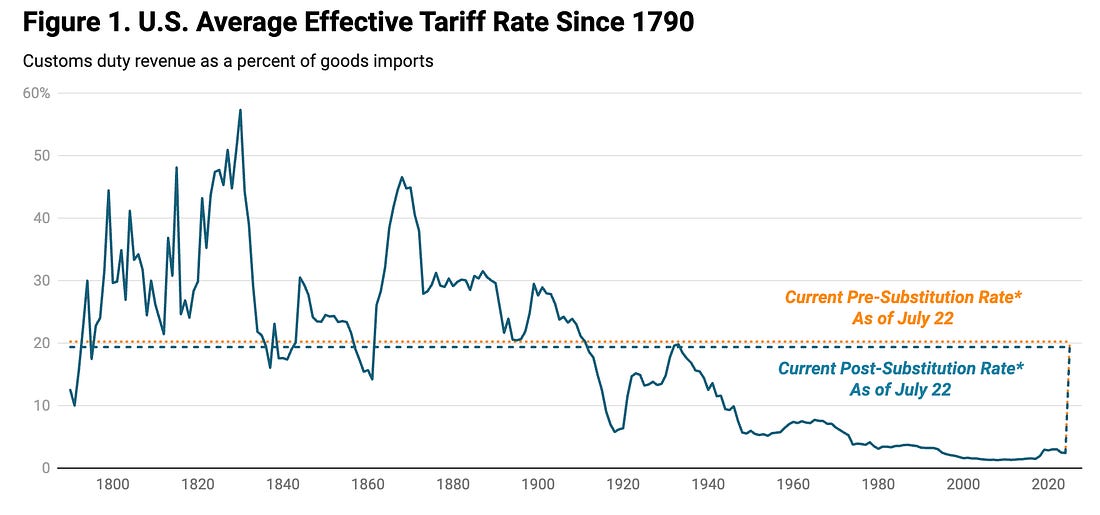
Under Trump, the United States has taken an amazingly sharp turn toward protectionism. Here’s the long view:

Source: Yale Budget Lab

In a matter of months, we’ve gone from a regime of very low trade barriers — achieved through generations of hard bargaining in international trade negotiations — to Smoot-Hawley-level tariffs. Many businesses, however, have taken comfort in the belief that extremely high tariffs were temporary, that they’d come back down as Trump began making deals with other nations.

But Japan has struck a deal — and is left facing a tariff of 15 percent, compared with an average of 1.6 percent BT (Before Trump.) Reports suggest that a similar deal may be coming with the European Union. At this point it looks as if we’re heading for a new normal in which most imports are taxed at 15 percent, while some face even higher tariffs.

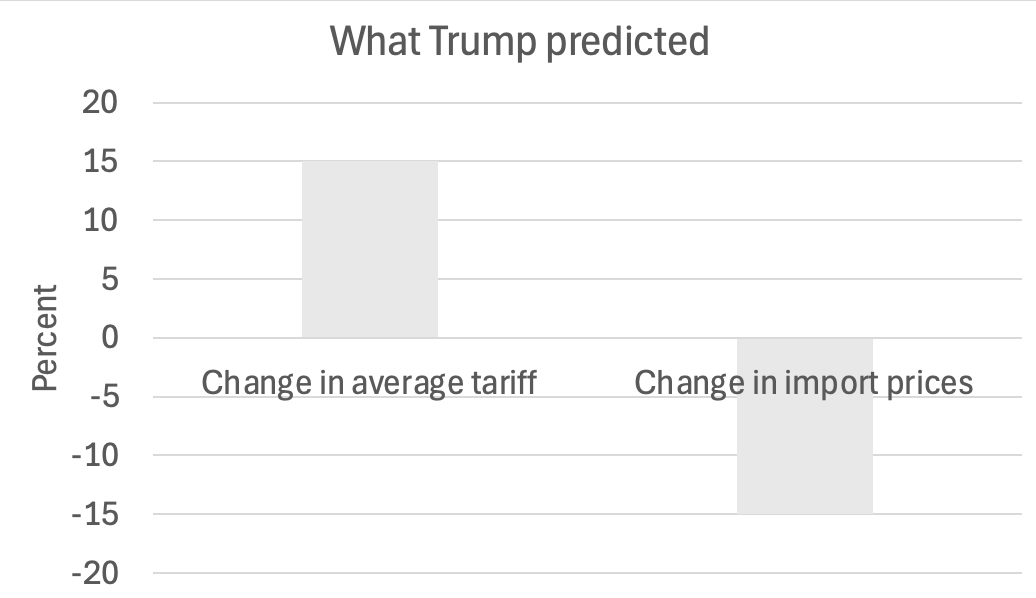
Trump claims that foreigners will pay these tariffs, and Trump apologists are pointing to consumer prices, which haven’t yet shown a clear spike, as evidence that he’s right. But they’re looking at the wrong price measure. What you want to look at are import prices — the prices foreign producers are charging America, prices tracked by the Bureau of Labor Statistics.

If Trump were right, we’d be seeing a large fall in import prices, offsetting the tariff hikes. It would look like this:

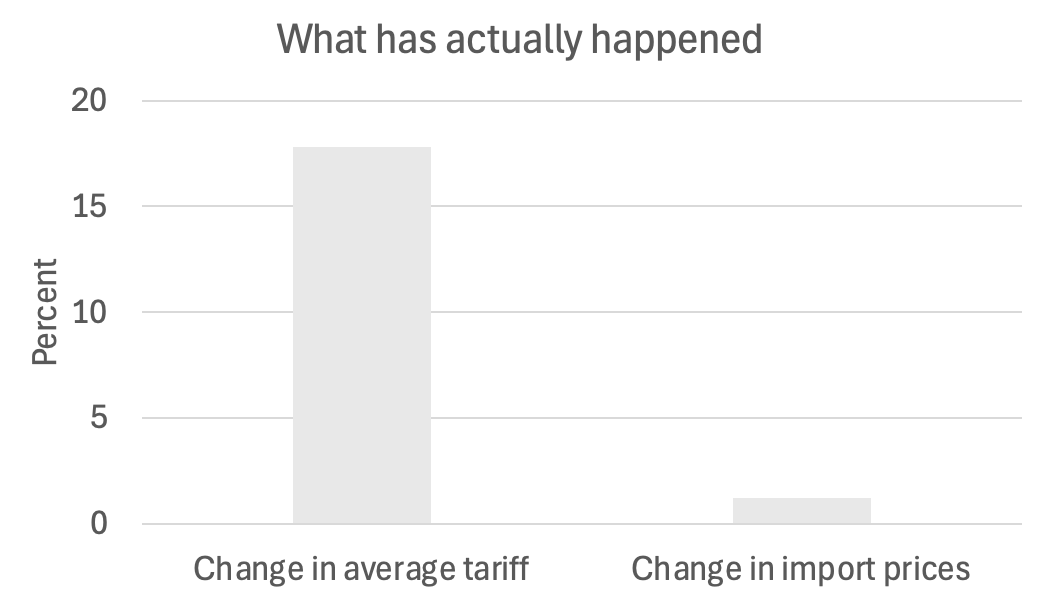
What we actually see is this:

Source: Yale Budget Lab, BLS. Import price is change in non-fuel index from year ago.

That is, if you look at the right price measures, foreigners don’t seem to be paying any significant share of the Trump tariffs.

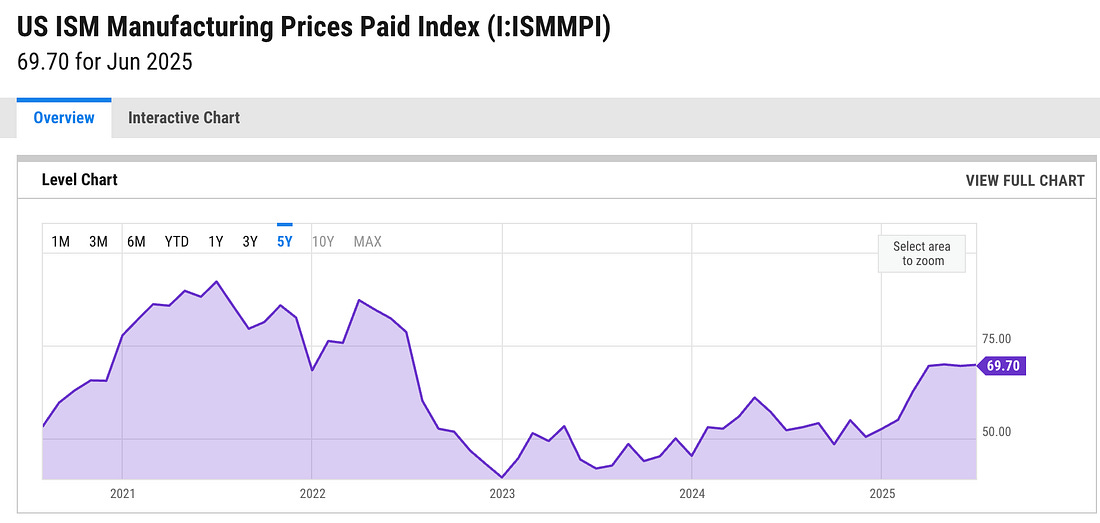
Who is paying? So far, the burden seems to be falling mainly on U.S. businesses, which are definitely seeing a sharp rise in costs. Look, for example, at the Institute for Supply Management’s report on manufacturing, which asks purchasing managers whether their costs have risen. The percentage answering yes has historically been a very good predictor of inflation a few months down the pike. And we’re currently experiencing cost inflation at levels not seen since the summer of 2022:

Source: YCharts

So far, these costs haven’t been fully passed on to consumers, probably in part because businesses have been expecting tariffs to come down. But once businesses see how high tariffs on Japan and Europe are afterthey’ve made deals, their willingness to absorb the tariffs rather than passing them on to consumers will evaporate.

So U.S. consumers will soon be suffering. But why are U.S. manufacturers so upset with the Japan deal? Because in combination with Trump’s other tariffs this deal actually leaves many U.S. manufacturers worse off than they were before Trump began his trade war.

This is clearest in the case of automobiles and automotive products. Trump has imposed a 25 percent tariff on all automotive imports, supposedly on national security grounds. This includes imports from Canada and Mexico. And here’s the thing: Canadian and Mexican auto products generally have substantial U.S. “content” — that is, they contain parts made in America. Japanese cars generally don’t.

But now cars from Japan will pay only a 15 percent tariff, that is, less than cars from Canada and Mexico.

OK, it’s not quite that straightforward, because imports from Canada and Mexico receive a partial exemption based on the share of their value that comes from the United States. Yes, it’s getting complicated. But we may nonetheless now be in a situation where cars whose production doesn’t create U.S. manufacturing jobs will pay a lower tariff rate than cars whose production does.

Wait, there’s more. Trump has also imposed 50 percent tariffs on steel and aluminum, which are of course important parts of the cost of a car. Japanese manufacturers don’t pay those tariffs.

Overall, the interaction between this Japan deal and Trump’s other tariffs probably tilts the playing field between U.S. and Japanese producers of cars, and perhaps other products, in Japan’s favor.

If this sounds incredibly stupid, that’s because it is. So how did this happen?

You might imagine that making a deal with one of our most important trading partners must have involved a team of experienced, skilled negotiators backed by economic experts. But in reality it was clearly pure amateur hour. Look at the photo at the top of this post, from CNBC. It shows Trump with a card in front of him laying out one much-hyped though probably meaningless part of the deal, a promise by Japan to invest in America. How much? The card says $400 billion, but that number was crossed out by hand and replaced with $500 billion, which somehow became $550 billion in the final announcement.

Next thing you’re going to tell me that Trump will start modifying weather forecasts with a Sharpie. Oh, wait.

So Trump’s negotiators probably had no idea what they were doing, and didn’t realize that in their frantic rush to conclude a deal they were agreeing to tariffs that would be highly unfavorable to U.S. manufacturing.

Why were they frantic? Trump has been the subject of considerable mockery over having made big promises about his ability to negotiate trade deals, then coming up empty month after month. So he and his people were surely anxious to make some major announcements before his self-imposed deadline of Aug. 1 — anxious enough not to realize quite what they were agreeing to.

And of course they may also have hoped that a splashy trade deal would move the news cycle off Jeffrey Epstein.

Now that other countries have seen what Japan was able to get away with, I won’t be surprised if we see more deals in the near future. Will these deals be just as stupid? Probably."


Thursday, July 24, 2025

How Many Steps Do You Really Need in a Day?


Walking 10,000 steps a day has long been a fitness cliché. But new research suggests that the health benefits of walking ramp up until about 7,000 steps — before leveling out. And as daily goals go, that’s a little more attainable.

Written by  - NY Times - 24 July

"The analysis, published today in the medical journal The Lancet Public Health, examined data from 57 studies and found that even moderate amounts of walking were associated with a lower risk of dementia and cardiovascular disease, among other conditions, adding to a wide body of research tying walking to longevity. People who walked 7,000 steps a day (roughly three miles) also had a 47 percent lower risk of death compared with those who walked 2,000 steps, the analysis found.

“It is just as important to walk 7,000 steps a day as it is to take your pills,” said Dr. Joshua Knowles, a cardiologist at Stanford Health Care.

Decades of research shows that walking improves metabolic health, making the heart stronger and more efficient while also reducing weight, cholesterol and blood sugar levels, said Keith Baar, a physiologist at the University of California, Davis.

While most scientific reviews have looked at how higher step counts are linked to lower risk of cardiovascular disease and death, the new analysis examined associations across a much broader range of conditions. For example, the study found that walking 7,000 steps a day was associated with a lower risk of Type 2 diabetes, depressive symptoms and cancer death, when compared with 2,000 steps.

Experts said the most surprising finding was the nearly 40 percent lower risk of dementia in people who walked 7,000 versus 2,000 steps a day. While the exact mechanism isn’t clear, exercise is linked to new neuron growth, greater blood flow to the brain and less neurological inflammation, said Dr. Nikhil Palekar, the director of the Stony Brook Center of Excellence for Alzheimer’s Disease.

“Getting up and moving has got to be the top priority,” Dr. Knowles said.

For decades, 10,000 steps was touted as the magic number for good health. But the recommendation is more myth than science, and researchers have debunked it in recent years.

“We don’t have any evidence for 10,000 steps,” said Melody Ding, an epidemiologist at the University of Sydney School of Public Health and the lead author of the new study. “It’s just a really big random number that people throw out there.”

The analysis found that there was no significant difference in the risk of falls, cancer, Type 2 diabetes and cardiovascular mortality between people who walked 7,000 versus 10,000 steps per day. There was some improvement beyond 7,000 steps for the risk of dementia and death, although it was small, Dr. Ding added.

The health benefits of walking are like juicing an orange: The first few squeezes give the most juice, but after a while, things start to dry up. In the study, increasing from 2,000 to 4,000 steps a day was associated with a 36 percent lower risk of death, while going from 4,000 to 7,000 was linked to a 17 percent lower risk. The gains flatten further beyond that.

Higher step counts are not harmful, said Hannah Arem, an epidemiologist at MedStar Health Research Institute in Washington — but nobody needs to feel guilty if they can’t hit 10,000.

Moving, Even a Little Bit, Matters

The new data only shows a correlation and cannot prove that walking caused these health benefits. After all, people who walk more tend to be less frail and eat better, potentially muddying the results, said Dr. Seth Martin, a cardiologist at Johns Hopkins Medicine. The specific risk reduction for dementia should also be interpreted with caution, since it was based on just two studies.

Experts also say that intensity still matters. So, on your daily walk, consider adding lunges, picking up the pace or choosing a route with hills or stairs.

Regardless, the evidence is overwhelming that “any steps are good steps,” Dr. Martin said. And while not everyone can remember how many minutes they’ve exercised, almost everyone can track their steps over time with their smartphone.

“If you improve your step count, you are impacting your health across the board,” he said.