

Editor's Proof
Christmas Season, 1973
In the dark days of a Moscow winter, foreign residents found ways to bring light to the season.
The Soviets didn’t openly celebrate Christmas. Instead, the genius of the Communist system was reimagining the holiday, shifting traditions to New Year’s celebrations.
Ded Moroz (Old Man Frost) and his helper Snegurochka (Snow Maiden) would toss candies to children as they passed through neighborhoods leading up to the holiday - Ded Moroz, looking strikingly like St. Nick. Of course, no one commented on the resemblance aloud.
For those of us far from home, Christmas became something we created ourselves. Foreign residents decorated apartments, embassies, and offices. The American Express office sat next to Air Canada and just down the hall from Lufthansa—a cluster of supportive managers and staff who turned the season into something special.
October brought its own rituals—this year friends and I gathered to place orders with Neiman Marcus, drawn by their elegant gifts and stunning wrapping paper. I had plans to surprise Natalie and a few friends with uniquely designed gifts that year.
In early November, we’d send our drivers out to reserve “New Year’s” trees. Rubles and a bit of foreign currency secured them for delivery by the second week of December.
Little did I know, all those plans would soon go sideways.
A month or so before the seasonal festivities began, several of us wanted to combat the dreary gloom of Moscow by ordering elaborate gift items from the world-famous Neiman Marcus store in Dallas, Texas.
Numerous embassies ordered their catalogs which included such fantasies as a “his and her’ gift. Embassies always ordered enough for distribution to their citizens living in “Fun City East.”
This particular year NM offered his and her aircraft. A previous year NM offered an Ark complete with animals and a veterinarian and staff as opposed to the offering to the pessimist in the family: a vault in Norway to secure worldly possessions.
When we had enough catalogs, we decided to meet in a conference room in the British Embassy on Nab. Morisa Toreza 14.
It was quite the gathering of Yanks, Australians, Germans, Canadians, Swedes, Finns, French, Brits, Norwegians, and others I fail to recall.
We poured over the selections shaking our heads at the insanity of some of the offerings that exceeded a million U.S.
I zeroed in on a PFAFF sewing machine from Germany, but offered by an American retailer. Crazy!
Natalie had mentioned several times how she wished she had access to a machine superior to the Soviet one she continually cursed.
I added a container of cookies and candies, a tin of Harvest bread, and a beautiful Hermes scarf. I decided how I wanted the gifts wrapped and that they would be part of a structure that looked like a medieval church inclusive of candy stained glass windows and tiny lights that could be lit.
I asked an American diplomat if I could ship it to the embassy. He told me the Ambassador had restricted receiving Christmas packaging to his staff.
I got the same reply from the rest of the group so I needed to order using the Metropole Hotel address, where American Express was located, at Pl Sverdlova 2/4 as my gift destination.
When we had all completed our wish lists, Brian, the Cultural Officer at the British Embassy, put together a secure message to Neiman Marcus requesting invoices, in each of our names be sent to their embassy's address in Vienna.
The packages would be sent to each country's embassies in Helsinki.
All communications leaving the CCCP were coded, routed to a Vienna embassy, or another destination, and then sent from that embassy to the destination.
In this case it went via London.
Postal mail was brought from Vienna and Helsinki by courier to the Moscow embassies. Almost all the western embassies used Vienna and Helsinki for mail.
Each of us ordering from NM, or other companies, would pay for our purchases from accounts outside of Russia in case the Russians were trying to run a game on any of us. In my case I had a number of accounts in European Banks as well as at the Chase Manhattan Bank in New York.
My order, and a couple of airlines companies representatives, were the only ones that would require clearing Soviet customs.
Procedures for receiving goods through Russian customs were generally overseen by a customs agent familiar with dealing with western companies.
Quarterly my staff would order office supplies, coffee, printer supplies, and a smattering of incidentals through Vesterbro in Copenhagen.
Our office would receive a telex when the trucks left Copenhagen with a scheduled delivery date to Moscow. If all went well the Soviet customs agent would call our office notifying us that the shipment was awaiting pickup from their offices near Sheremetyevo Airport.
When we received the call one of the staff would ask Vadim, my driver, to head out and pick up the goods, unless I had a need to be driven anywhere.
The system worked well, but slowly.
We had what I thought was a solid relationship with customs.
This particular Christmas I decided to order from Europe large wicker baskets chukker full of cheeses, wine, meats, cookies, Finnish Vodka, tinned fish from Norway, Sweden and Iceland plus boxes of chocolates for thirty or so Russians we had business relationships with. It was also a way to rub their noses in how their godless paradise had nothing like what was available in the west.
Oy Stockmann, on Aleksanterinkatu 52, Helsinki, a store comparable to Harrods or Galeries Lafayette in Paris was accustomed to serving the diplomatic and the business community in Moscow.
The Finnish Embassy, in Moscow, allowed products ordered in Finland to be brought to Moscow in a lorry under diplomatic seal.
Throughout the year the Finnish Embassy brought milk from Helsinki to Moscow each week as Soviet milk was not homogenized.
The American Embassy allowed us, and the growing number of American business reps, to pick up milk every Friday that had been delivered to the Finns.
During the second week of December our Christmas baskets arrived at the Finnish Embassy. Vadim had to make five trips to get them all tucked away in our office back room.
Each of the staff received one of the baskets prior to Vadim putting together a delivery schedule for my review.
To say the staff was overjoyed is an understatement.
I had arranged annual foreign travel for each staff member. A number of them went to Vienna, one to London, one to Athens and one to Finland. I always arranged for them to stay in the best hotels, to be picked up by car at the airport and that the local American Express staff or the staff of an Amex Representative office would host them, show them around and let my staff see what was available outside the CCCP. I would hear from those various staffs how much my staff enjoyed themselves.
Interestingly, my staff never spoke about their experiences around me, ever.
Christmas was almost on us when customs alerted my office that the packages from America had arrived, but that they would not be released until after the New Year celebrations.
When I was informed of that I asked Nina, my most connected staff member, to call the Customs Director, Ivan Zapromotov, pleading for the release of the gifts prior to the 25th. She was told, by his assistant, that we should call back the first week of January.
Not wanting to disappoint Natalie I decided that Vadim and I would go to customs to deliver our Christmas baskets to our contact Aleksandr, who had always been a “friend” at customs, and to Director Zapromotov and his aide.
Nina would call them, when we were on the way, saying I was on the way to deliver our “New Year’s” gifts. She would not bring up the packages they had failed to release.
I had Vadim put a case of Tullamore D.E.W., the finest Irish whiskey, in my opinion, and a case of American Michter’s Kentucky Straight Bourbon on the back seat of our Volvo. He would toss in a few cartons of Marlboros which were the gold standard of “thanks for your service” handouts.
The cop on the corner in front of the Bolshoi allowed us to turn left rather than circle up in front the KGB headquarters and Children’s World, a sad toy shop across from the subterranean prison within Lubyanka.
I was prepared to make an offer to the customs people that they couldn’t refuse. Actually, I was prepared for Vadim to make an offer they couldn’t refuse. I would never offer an inducement myself as that may lead to a long stretch in the Gulag.
Vadim handled everything.
He always had coupons in various denominations sticking out of his blazer pocket making it all too obvious to those who could get a real boost from our generosity.
Russians were unable to purchase any foreign liquors unless they were connected enough to have access to the foreign currency based shops that were for the exclusive use of foreign residents, staff paid in negotiable coupons and those who received coupons as “gratuities”.
A single bottle of Irish Whiskey, or a bottle of American Bourbon could be sold for hundreds of Roubles, additionally churning the black market and corruption.
Russian Vodkas for public consumption were gut rot with aluminum tear off tops that were guzzled for unconsciousness, not for pleasure. When the top was ripped off the intent was to drink the whole bottle.
The idea of a cocktail was absurd.
A bottle of export Stolicnaya in the hard currency shop costs around two dollars. American cigarettes were less than three dollars a carton.
Vadim and I handed out "gifts" freely to anyone who could help make our lives and business dealings smoother. I never inventoried or audited our supplies, trusting that my staff took only what they needed to make life a little more enjoyable for themselves and their families.
Once the car was loaded with goodies, we set off. Snow was falling, with a blizzard in the forecast. We needed to make the trip out and back quickly.
Fortunately, the company Volvo was equipped with spiked tires, so ice and snow weren’t usually a problem.
The airport and customs were about 29 kilometers away, but with the weather worsening, we gave ourselves two hours to make it there and return to the office at the Metropole.
When we arrived we had to que behind a long line of lorries and GAZ Chaikas. Anyone being driven around in a Chaika, with back curtains drawn, was someone highly connected in the “take according to your needs” Utopia.
Vadim muttered the usual Russian obscenities about dogs and mothers as he came to a stop. Well-known among the driver corps, he told me he’d check out the situation at the front of the queue and see if we could jump ahead. I knew it was wishful thinking—drivers of the Chaikas would never allow it.
I watched as he stopped, talked, and laughed with several of them. I had full confidence in his ability to smooth things over, knowing he’d never push too hard with people who could ruin his life with a single phone call.
After a bit, Vadim returned to our car telling me we would have about a half hours wait until we got into the pick up area around a corner, under a slanted roof that was rapidly collecting snow.
Vadim had informed our customs contact that I wanted to present our New Years gifts to the Director, which I knew would draw him to our car for a quick chat and to receive his booty.
My hope was he would release our shipment when I acted ignorant by asking if he knew if they had received our order from the States.
After almost an hours wait we drove into the pickup area where we sat waiting for Zapromotov.
He kept us waiting for another half hour as a show of his authority and total disdain for the long que of Russian drivers behind us around the entrance of the pickup area.
Typical Soviet behavior to keep the pickup area out of view of others. In this case I hoped we could gift our way into getting our packages without anyone else seeing the exchange of goods.
When Zapromotov walked to the car I exited to give him a warm greeting and wishes for a Happy New Year. We smiled, shook hands, spoke of the impending blizzard, etc.
As Vadim was unloading the wicker baskets for him, his assistant and our customs rep I asked him about our shipment and how much I wanted to share New Years gifts with my friends.
He was silent, ignoring my question.
Damn!
I slowly moved closer to the back door of the car so he could see the cases of whiskey and cigarettes.
I didn’t know him well and took a deep breath when I asked again about our packages.
It was obvious I was going to give him anything he wanted if he ok’d a release.
I looked at him saying,”perhaps I can offer some spirits for your celebrations.”
He looked at me as only Soviets could, sending a chill up my spine as I wondered if I'd used the wrong words in my offer.
If he charged me with attempted bribery I’d never leave customs.
He broke eye contact saying, “ Let me go to my office.”
I stood in the freezing cold waiting for him to return wondering if he was calling the militia. I noticed Vadim had moved across the drop off area where he was talking with customs workers.
Jesus, he’s moved away from me in case the cops show up. He can deny everything other than being the driver taking orders.
Zapromotov returned.
He stopped by the back door looking at the cases of whiskey, saying, “Mr. Garrett, your shipment has being received but has not yet cleared security or inspection. We will call you in some weeks informing you when you can come and pay duty should that be most appropriate.”
He turned and walked back through the door.
Fucker.
We drove back to the city through heavy snow in silence.
I realized I had just met the single most honest bureaucrat in the entire country. Perhaps me going out there was a mistake and that Vadim by himself may have pulled it off.
When I got back in the hotel I checked with Marshall at Air Canada and Lars at Lufthansa. They hadn’t yet sent anyone out to customs yet and based on my experience decided not to bother.
I rushed around town buying what I could for Christmas.
Everyone understood how things worked so no feelings we hurt.
On Monday, in the third week of January, we were informed we could pick up our order and pay a $585.00 duty. It was pointless to ask how they achieved that number so I went to the small safe adjacent to my desk, in my separate office from the public one, to fan out the money to Vadim.
Hours later he returned with the packages.
Someone had stripped off all the wrapping paper and dismantled the structure of the planned presentation.
No explanations offered and none asked.
The same was done to all the others who ordered with delivery through Russian customs.
I was overjoyed that no one accused me of attempted bribery and that I didn’t land in Lubyanka just up the street from my office.
Life in Moscow!!
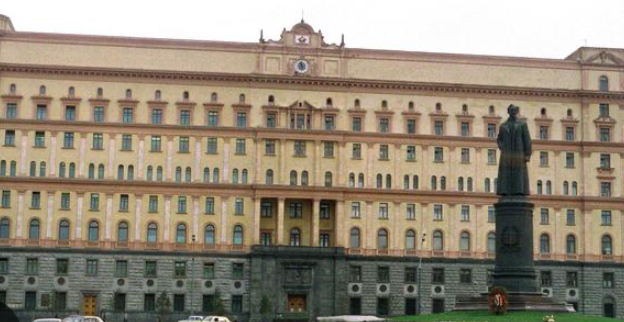
Lubyanka Square in downtown Moscow is the site of the site of the Lubyanka head-quarters of the KGB. KGB directors from Lavrentiya Beriya to Yuriy Andropov had their office on the third floor of the building. The center of the square was dominated centre by a statue of Felix Dzerzhinsky, founder of the first communist secret police, the Cheka. Like many others, the statue was removed in August 1991.
The Lubyanka actually consists of three buildings. The main yellow building, which is often shown on television, predates the Revolution and was taken over by the Bolsheviks in 1918. Containing the Lubyanka prison, this building is now the headquarters of the Border Troops, and it also contains a single Federal Security Service (FSB) Directorate. The Federal Security Service headquarters building is the gray one to left side, No. 1/3. whose construction began under Andropov and was finished under Chebrikov.
Since 1984 (when KGB chief Yuri Andropov became chairman of the Communist Party and decided to improve the KGB's public image) tourists have been able to visit a KGB museum in a gray stone building behind the Lubyanka. The upper floors are KGB offices, but the ground floors are used for conferences and a clubroom for retired KGB offices, featuring a disco, among other things. And since the Soviet collapse in 1991, Russia's intelligence agencies have tried to create an impression of openness, giving guided tours through the yellow Lubyanka. The new KGB Museum, which is open to the public, is housed in the Lubyanka building. Across the square from the Lubyanka is Dyetsky Mir (Children’s World), the largest children’s shop in the country.
© 2025 M. Barrett Miller
“In the Scrub”
“Life in the Shadows”
All rights Reserved.
All rights Reserved under the International and Pan-American Copyright Conventions.
No part of this book
may be reproduced or transmitted in any form or by any means,
electronic or mechanical, including photocopying, recording,
or by any information storage and retrieval system, without permission in
writing from the author.


