Where is George Bush?
Is he so cowardly he cant stand up for what he STOOD for?

Welcome to Let Kids Be Kids, Inc., advocacy blog "We All Deserve Better." Our goal is to post relevant information that will spark action,discussion and interaction, creating a catalyst for solutions and ideas to impact the challenges we face in our society. We welcome comments, suggestions and submissions in support of those seeking a voice. "...Courage is not the absence of fear, but rather the judgement that something else is more important than fear..."
Where is George Bush?
Is he so cowardly he cant stand up for what he STOOD for?

challengeer007
A Gritty, REALISTIC Thriller with Realistic Tension
Reviewed in the United States on June 11, 2025
Beyond the Black Stump delves into a world where political corruption exists, murder is a transaction in the shadows, and morals become secondary to loyalty and betrayal. Considered part of the *Life in the Shadows* series, Mahaney's potentially legit assessments of things going on with the SAS, the extensive international conspiracy, and the attempted assassinations against the Royal Family ensure grit, suspense and pacing. Mahaney's acknowledgment page adds a layer of realism to the historically based albeit fictional story—and a twist—along with Mahaney's speculation attesting to his country's military involvement in such disasters makes this harsh reality all the more painful because one would think that allies would stand by one another. But nothing is guaranteed. Those interested in geopolitical thrillers will enjoy this as a suspenseful, insane read.


An estimated 1.8 million Muslims are preparing to embark on the Hajj pilgrimage to Mecca which begins on June 4.

"Friends,
Why is Trump trying to cancel “Sesame Street,” which has helped children learn to read and count for over half a century?
Why is he seeking to destroy Harvard University?
Why is he trying to deter the world’s most brilliant scientists from coming to the United States?
Because he is trying to destroy American education — and with it, the American mind.
Throughout history, tyrants have understood that their major enemy is an educated public. Slaveholders prohibited enslaved people from learning to read. The Third Reich burned books. The Khmer Rouge banned music. Stalin and Pinochet censored the media.
And Trump, like past authoritarians, wants to control not just what we do, but also how and what we think.
He has embraced one of the mottos from George Orwell’s 1984: “Ignorance is strength.” He knows that an uninformed public is easier to divide and conquer.
There are five facets to Trump’s authoritarian attack on the American mind:
The protagonist of 1984 works in the so-called Ministry of Truth, where he’s made to literally rewrite history because Big Brother knows that he “who controls the past controls the future.”
That’s chilling in a dystopian novel. It’s far scarier in real life, where Trump and his MAGA cronies are making schools whitewash slavery and segregation, cover up the genocide of Native Americans, and erase the LGBTQ+ rights movement.
Authoritarians know that if they can convince us our country has never been wrong, they can make us believe our ruler is always right.
If they can make us forget how brave activists fought for change in the past, they can stop us from seeking change in the future.
Trump wants us to forget (or never know) that he lost the 2020 election and then instigated a coup against the United States.
He even claimed last weekend that former President Joseph R. Biden was “executed in 2020” and replaced by a robotic clone.
As Trump tries to abolish the Department of Education, he’s also proposing to cut funding for K-12 public schools and to force universities to let him influence student admissions, faculty hiring, and what is taught.
As a professor, I know firsthand how education empowers young people’s minds. We can’t have a functioning democracy if people cannot deliberate critically about it. That’s why authoritarians replace education with indoctrination.
But the Trump regime doesn’t want a functioning democracy.
Instead of teaching students to think for themselves, authoritarians seek to instill blind allegiance and suppress dissent. As Trump adviser Stephen Miller said: “Children will be taught to love America. Children will be taught to be patriots.”
This is why the Italian and German fascists of the 20th century immediately turned their countries’ educational systems into instruments of the party.
By freezing university research grants and attacking the National Institutes of Health, the National Science Foundation, and USAID, Trump is stifling medical and scientific research.
And his cuts to the Centers For Disease Control and the Food and Drug Administration put all of us at risk.
He’s also abducting and deporting international scientists who disagree with his administration. Can you imagine a crueler way to rob America of the global intellectual capital that has helped us become the world leader in scientific research?
He is now revoking visas of some Chinese college students. Some 277,000 students from China attended school in the United States last year, second only to the number of students from India. The United States employs tremendous numbers of scientific and technological experts originally from China. We need this continued pipeline of intellect and skill.
How can medical research and disease prevention be political? How can scientific research in general become political? Why is Trump afraid of science?
Because science acknowledges objective facts. Authoritarians insist that the ruler is more powerful than the facts. Trump wants to control the facts.
As George Orwell wrote, “it means a loyal willingness to say that black is white when Party discipline demands this.”
From suing ABC and CBS over their news coverage to threatening to strip network broadcast licenses to defunding PBS and NPR, Trump is trying to silence America’s sources of news.
As Trump repeatedly says: “I call it the fake news media.”
He wants control over what information Americans can (or cannot) get.
His regime is even going through social media accounts of people seeking visas to the United States.
A free press exists to question authority and help the public question it as well. But authoritarians insist that they must never be questioned.
Authoritarians want to consolidate state power over what the public can know.
The arts exist to provoke us, challenge our thinking, and help us see beyond ourselves.
They arts are an important and independent aspect of an educated society, which is why authoritarians have historically attacked them.
So it’s no surprise that Trump is canceling grants from the National Endowment for the Arts, is dictating what’s displayed at the Smithsonian, and has installed himself as the chair of the Kennedy Center for the Performing Arts.
To limit art is to limit free speech and expression. It’s a crucial step that authoritarians use to silence anyone who dissents through creativity.
***
Added up, these five facets of Trump’s attack on the American mind render us less informed, less inspired, and easier to control.
They empower him to divide us with hatred and fear.
And they prevent us from discovering that we have more in common with one another than with the authoritarians who try to rule us.
This attack on our minds reduces our capacity for self-government because ignorance is the handmaiden of tyranny.
What you can do: Please share this essay, and help spread the truth."

AmeriCorps has been a cornerstone of civic engagement across the country, with members providing vital support in disaster relief, habitat restoration, conservation, education, and public health. Here at Birds Connect Seattle, AmeriCorps members have been instrumental in advancing our mission—leading programs like Young Birders, Seattle Bird Collision Monitoring Project, Climate Watch, and environmental education in classrooms. Their contributions are both practical and profound, enriching the lives of individual children, teens, and adults, and strengthening our collective stewardship of the natural world.
Birds Connect Seattle has had the honor of hosting exceptional AmeriCorps members whose contributions have left lasting impacts on our organization through the years. Many states, including Washington state, have joined a multi-state lawsuit challenging the illegal executive order that terminated AmeriCorps grants. Until this comes to a resolution Birds Connect Seattle is facing uncertainty—both immediate and long-term—about how this abrupt discontinuation will affect our team, our programming, and our community partnerships.
We are grateful for your continued support as we navigate this difficult moment.
How You Can Help:


From the Guardian - 28 May - Richard Lea and Sian Cain
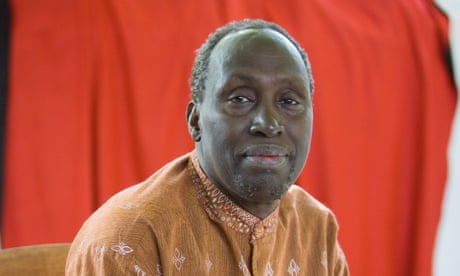
"The Kenyan writer Ngũgĩ wa Thiong’o, who was censored, imprisoned and forced into exile by the dictator Daniel arap Moi, a perennial contender for the Nobel prize for literature and one of few writers working in an indigenous African language, has died aged 87.
“It is with a heavy heart that we announce the passing of our dad, Ngugi wa Thiong’o, this Wednesday morning,” wrote his daughter Wanjiku wa Ngũgĩ on Facebook. “He lived a full life, fought a good fight.”
He died in Atlanta, and his daughter said more details would be announced soon.
“I am me because of him in so many ways, as his child, scholar and writer,” his son Mukoma Wa Ngũgĩ wrote on X. “I love him - I am not sure what tomorrow will bring without him here. I think that is all I have to say for now.”
Ngũgĩ explored the troubled legacy of colonialism through essays, plays and novels including Weep Not, Child (1964), Devil on the Cross (1980) and Wizard of the Crow (2006). Consider a giant of the modern African pantheon, he had been a favourite for the Nobel prize in literature for years. After missing out on the prize in 2010 to Peruvian author Mario Vargas Llosa, Ngũgĩ said he was less disappointed than the photographers who had gathered outside his home: “I was the one who was consoling them!”
Born in 1938, while Kenya was under British colonial rule, Ngũgĩ was one of 28 children, born to a father with four wives. He lived through the Mau Mau uprising as a teenager, during which the authorities imprisoned, abused and tortured tens or even hundreds of thousands of people. During the conflict, Ngũgĩ’s father – one of the Gikuyu, Kenya’s largest ethnic group – was forced off his land, and two of his brothers were killed.
This struggle formed the backdrop to the novel that made his name: Weep Not, Child. Published in 1964, just a year after Kenya gained independence, it tells the story of the education of Njoroge, the first of his family to go to school, and how his life is thrown into turmoil by the events which surround him.
A series of novels, including short stories and plays followed, as Ngũgĩ became a lecturer in English literature at Nairobi University. There he argued that the English department should be renamed, and shift its focus to literature around the world. “If there is need for a ‘study of the historic continuity of a single culture’, why can’t this be African?” he wrote in a paper. “Why can’t African literature be at the centre so that we can view other cultures in relationship to it?”
In 1977, he published his fourth novel, Petals of Blood, and a play, The Trial of Dedan Kimathi, which dealt with the troubled legacy of the Mau Mau uprising, but it was his co-authoring of a play written in Gikuyu, I Will Marry When I Want, which led to his arrest and imprisonment in Mamiti maximum security prison.
“In prison I began to think in a more systematic way about language,” he told the Guardian in 2006. “Why was I not detained before, when I wrote in English?” He decided from then on to write in Gikuyu, that “the only language I could use was my own”.
Released in 1978, exile followed in 1982, when the author learned of a plot to kill him upon his return from a trip to Britain to promote his novel Caitani Mutharabaini, translated as Devil on the Cross. He later moved from the UK to the US, where he worked as a professor of English and comparative literature at the University of California, Irvine, and headed its International Centre for Writing and Translation.
Ngũgĩ continued to write in Gikuyu, despite his troubled connection with his homeland; an arrest warrant was issued for the fictional main character of his 1986 novel Matigari, which was also banned in Kenya. Returning to Nairobi with his wife Njeeri for the first time in 2004, two years after the death of Daniel arap Moi, Ngũgĩ was greeted by crowds at the airport. But during the trip, men wielding guns broke into their apartment, raping Njeeri and beating Ngũgĩ when he tried to intervene. “I don’t think we were meant to come out alive,” he told the Guardian two years later.
His novel Wizard of the Crow, translated by the author into English in 2006, returned to the subject of African kleptocracy, being set in the imaginary dictatorship of the Free Republic of Aburiria. He said the “most beautiful sentence in the entire novel” was “a translation from Gikuyu by the author”.
He continued to translate his own works from Gikuyu, and was nominated for the international Booker prize in 2021 for his epic novel-in-verse The Perfect Nine. He was the prize’s first nominee writing in an indigenous African language and the first author to be nominated for their own translation.
Ngũgĩ had been diagnosed with prostate cancer in 1995 and underwent triple heart bypass surgery in 2019.
Ngũgĩ had nine children, four of whom are authors: Tee Ngũgĩ, Mũkoma wa Ngũgĩ, Nducu wa Ngũgĩ, and Wanjiku wa Ngũgĩ.
“Resistance is the best way of keeping alive,” he said to the Guardian in 2018. “It can take even the smallest form of saying no to injustice. If you really think you’re right, you stick to your beliefs, and they help you to survive.”